Autism diagnoses have risen in recent decades, which has ignited fear and debate into understanding why autism has become more prevalent. In September 2025, President Trump and the HHS warned pregnant women that Tylenol could cause autism. Azeen Ghorayshi, a science reporter for the New York Times, argued that characterizing this as an “epidemic” is misleading, explaining that the rise in diagnoses stems from an increased public awareness and a broadening of diagnostic criteria, which are now understood as a spectrum.
Some claim that autism has been linked with vaccines, but such claims by anti-vaccine activists have been debunked. Vaccines are a miracle in human achievement. However, diseases such as measles have recently experienced a resurgence. But we’ll return to that later.
In my research, I found that a single discredited 1998 study by gastroenterologist Andrew Wakefield was responsible for this misinformation. Wakefield and other authors published a report in The Lancet linking the MMR (measles, mumps, rubella) vaccine to intestinal inflammation, which they hypothesized would allow malignant proteins to enter the bloodstream. Wakefield found that these toxins in the blood would negatively impact the brain and development, leading to autism.
However, the sample size of this study was only 12 children. Later in the 2000s, an investigative journalist for The Sunday Times named Brian Deer exposed undisclosed large financial contributions to the study by lawyers building a lawsuit against vaccine makers. Deer also discovered that Andrew Wakefield filed a patent for his own vaccine, which was a major conflict of interest. Deer wrote a book about the Lancet MMR autism fraud, The Doctor Who Fooled the World: Science, Deception, and the War on Vaccines. In 2004, 10 of the study’s 13 authors withdrew their findings. In 2010, The Lancet retracted the study fully, and Wakefield was stripped of his license for misconduct.
That said, the hypothesis still prompted investigation and more research. Studies with larger sample sizes have concluded that there is no association between vaccines and autism. Even real-world examples pointed to this. For example, Japan ceased to administer MMR vaccines in 1993, but autism diagnoses continued to climb.
Although the Wakefield study was invalidated and compromised, the damage had already been done. Misinformation had spread and gave rise to negative outcomes in public health. It stoked skepticism and fear, and immunization rates declined significantly. There has even been a recent measles outbreak in the US.
Today, the anti-vax movement has employed several tactics to diminish the science and persuade others of misinformation.
One tactic is the use of humor and memes. Below is an image demonstrating this.
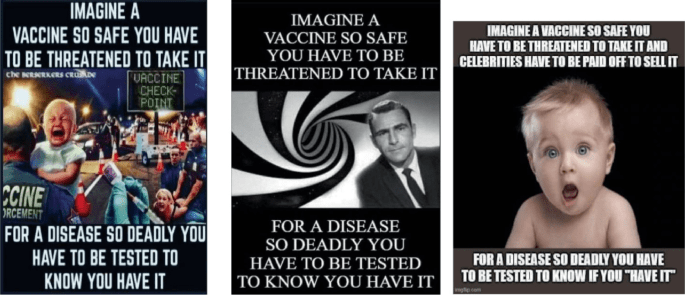
They also employ bias and shift the goalposts to fit their view. But their claims linking autism with vaccines are a correlation-causation fallacy. Anti-vaxxers fuel fear by making the ingredients sound unnatural or scary and leverage past scientific errors to undermine credibility. For instance, anti-vaxxers use ad hominem attacks, like the “pharma shill gambit,” to discredit defenders of vaccines. They say that vaccine supporters are in cahoots with pharmaceutical companies for profit.
Anti-vaxxers, as well as the Make America Health Again (MAHA) movement, also frame language to support their view, such as the term pro-safety. Robert F. Kennedy, the current Secretary of Health and Human Services, said early last year, “News reports have claimed that I am anti-vaccine or anti-industry. I am neither. I am pro-safety.”
The modern-day internet has only exacerbated this misinformation. Anna Kata, an anthropologist specializing in vaccine hesitancy, has explored another tactic to push parental intuition over science. Kata argues that there has been a postmodern paradigm shift in which people rely on online information and question scientific authority. The Wakefield study itself sparked media coverage, including attention by celebrity actor Jenny McCarthy, who advocated that personal intuition could be comparable or better than medical experts. “Through appearances on Larry King Live, Good Morning America, and Oprah, where she touted her “mommy instinct” and degree from the “University of Google,” McCarthy became a celebrity spokesperson against vaccines and pushed the issue into the mainstream.”
It’s unbelievable to think that measles was declared eliminated in 2000, but the ramifications of one discredited study caused so much damage to public health. The arrival of Web 2.0 and distrust in science has exacerbated the anti-vaccination movement and conspiracy.
Other Useful Sources
- Vaccines and the autism myth by Khan Academy (Part 1 and Part 2)
- PBS: Vaccine Skepticism Is Reviving Preventable Diseases
- Is There an Autism Epidemic?
- 2004 video documentary led by Brian Deer: MMR: What They Didn’t Tell You
 Anthony's Blog
Leave a comment